Top 5 of the Most Effective Gamification Mechanics in B2B
Ecco le due regole fondamentali da tenere a mente quando si organizza la prossima sfida di vendita. Questo feedback si basa su un sondaggio condotto tra responsabili delle vendite, organizzatori di sfide e partecipanti.


Sommaire
Les gamified motivational springs transform professional commitment into measurable actions. While 70% of Global 2000 companies deploy at least one gamified application, specific tools (rankings, badges, challenges, progress bars, boosters) are becoming essential to accelerate commercial and operational performance. Chez Objow, we observe that teams intelligently combining 4 to 5 professional fun devices record +83% engagement, +60% time savings, and +18% improvement in KPIs. Discover how to orchestrate these fun devices to transform your B2B teams into drivers of sustained performance.
Why gamification mechanisms are becoming essential in B2B
The levers of play applied to B2B are not entertainment, they are behavioral activation systems rooted in deep psychology. The framework Octalysis of Yu-kai Chou identifies 8 Motivational Core Drives : accomplishment, ownership, social influence, unpredictability, unpredictability, avoidance, scarcity, meaning and personal connection. Each mechanism activates one or more of these springs.
The distinction between intrinsic motivation (do something for fun) and extrinsic (for a reward) disappears when the fun levers merge the two. Creating clear goals, displaying progress visually, and recognizing status turns daily effort into a motivating journey. The concept of”Flow“by Mihaly Csikszentmihalyi highlights that maximum commitment comes when the challenge is balanced with existing skills.
T-Mobile activated corporate gaming devices for its 3,000 internal employees and observed +583% in employee contributions in 6 months. Ford Canada recorded +100% actions per user in 5 weeks. These results reflect strategic alignment: the right structured gamified approaches address real goals, not gadgets that are unrelated to business reality.

Gamification mechanics 1: rankings and leaderboards
Rankings are the glue behind all B2B gamification. One Leaderboard shows the ranking of the best performers according to key metrics (turnover, calls made, contracts signed, customer satisfaction). This mechanism simultaneously activates achievement, healthy competition, and avoidance, creating motivating tension.
Rankings produce results when criteria change regularly: daily for sales teams, weekly for media, per campaign for project teams. CNP Assurances has integrated this fun approach with Objow and is now watching +1 contract per advisor every 2 days. Visibility not only breeds competition, it creates collective responsibility: teams at the bottom of the rankings receive mentoring rather than isolation.
Prudence: permanent leaderboards exhaust through fatigue and toxicity. Integrate rotations (by zone, by product, by team) and closed windows of 3 to 4 weeks maximum. This variation keeps friction motivating without burnout.
Gamification mechanics 2: visual badges and awards
Badges symbolize achievement. Contrary to abstract points, a badge weighs psychologically: it represents a step taken, a demonstrated skill, a threshold exceeded. This mechanism makes use of the”completion bias“: once 90% of badges have been collected, users are motivated to get the last one to complete the set.
Manpower deploys badges to recognize professional milestones: “First placement”, “10 confirmed placements”, “Sector specialist”. This approach has contributed to +16% active customers over 6 months. Badges also act as a career passport: they can be displayed on internal profiles, they can be mentioned in meetings, they can be integrated into annual evaluations. For distributed teams, these visual rewards materialize recognition when face-to-face meetings are lacking.
The challenges and Challenges limited in time
A time-limited challenge creates scarcity and urgency, two powerful Core Drives. Contrary to permanent goals that become routine, a closed challenge (“Reach 5 customer appointments before 6 p.m. on Friday”) triggers immediate motivating tension. This approach is naturally in line with business cycles: end of month, seasonal campaigns, product launches.
Successful challenges are clear (explicit criteria), achievable (60-80% of the team can succeed), and linked to immediate rewards. MGEN deployed a monthly series of gamified challenges via Objow to animate 1,200 managers and commercial. Each challenge unlocks badges and points that can be converted into concrete benefits. Result: +40% participation to training initiatives since launch. Challenges are also excellent for testing new behaviors without imposing them as permanent obligations.
Progress bars and level systems
The progress bar visualizes the path between present and objective. It meets two needs: clarity (“Where am I?”) and meaning (“My effort counts”). A 94% bar immediately says “you are almost there”, where an abstract numerical objective leaves one in doubt. Level systems structure long-term progression: each user climbs from level 1 to level 5, with increased responsibilities and access at each stage.
PepsiCo uses a level system for field teams that are gamified with Objow. Reaching Level 3 unlocks exclusive formations, trading bonuses, and strategic access. Result: +92% DN rate and improved retention of 18 months on average. The combination of short-term bars (daily/weekly) and long-term levels (quarterly) creates a clear motivating trajectory. Users see where they stand immediately AND understand how effort builds up towards greater rewards.

Gamification mechanics 5: boosters and multipliers
A booster is a temporary bonus that multiplies results. “Double points on Thursday” or “Multiplier x1.5 for any sale before 12 pm” creates positive unpredictability and fights fatigue. A well-calibrated booster can increase activity by 30-50% over its period. Boosters work remarkably when combined with other fun motivational levers: leaderboard + Thursday booster (x1.5) + weekly challenges (scarcity) + progressive levels (meaning) creates a motivating symphony.
Calibration takes precedence: too strong a multiplier creates injustice, too weak disappears psychologically. The sweet spot is between x1.3 and x2 over a period of 6 to 48 hours. Alternate boosters so the team doesn't predict the same pattern every week. This predictable variability maintains freshness without chaos.
Concretely, fun approaches based on boosters take several forms depending on the context. The volume booster rewards peak activity (“x2 points on the first 10 calls in the morning”). The collaborative booster multiplies the gains when the whole team reaches a collective threshold, strengthening cohesion. The Surprise booster appears without notice, triggering an adrenaline rush that breaks routines. At Objow, data shows that teams using rotating boosters maintain 35% higher engagement compared to teams without this variability. Note that boosters should remain occasional: 2 to 3 per month maximum to maintain their psychological effect.
Which gamification mechanism to choose according to your objective
Each tool addresses a distinct need. Rankings maximize healthy competition, badges maximize symbolic recognition, challenges create urgency, bars clarify progress, boosters inject variety. Your choice depends on the context: team strength, corporate culture, horizon (short/long term) and profiles of players present. La Bartle's taxonomy identify 4 profiles: Achievers (accomplishment), Socializers (community), Explorers (discovery), Killers (competition). An effective mechanism speaks to 2-3 of these profiles simultaneously.
The chart below guides your quick selection:
Critical limits and pitfalls to know
Poorly designed powerful playful engagement mechanisms disengage rather than engage. Three pitfalls dominate: first, fatigue by hedonic adaptation. If each action triggers reward, the brain gets used to it in 4-6 weeks. Solution: regularly vary the activated levers (week 1 ranking, week 2 challenge, week 3 booster), create closed cycles 4 active weeks then 1 week break, integrate surprise.
Second, toxic competition. When 20% of the team finds the goals impossible, they give up. Solution: create multiple parallel leaderboards (by product, region, account size), reward personal improvement week by week, not just absolute results, integrate collaborative challenges. CNP Assurances combines individual rankings and team challenges to transform toxic competition into healthy dynamics.
Third, overvaluing extrinsic motivation. In the long run, external rewards replace intrinsic motivation. Solution: link each lever to real progress in responsibility or expertise, celebrate learning not just results, offer time for professional development. The best mechanics activate fundamental need: control, autonomy and meaning.
How to orchestrate gamification mechanics for maximum impact
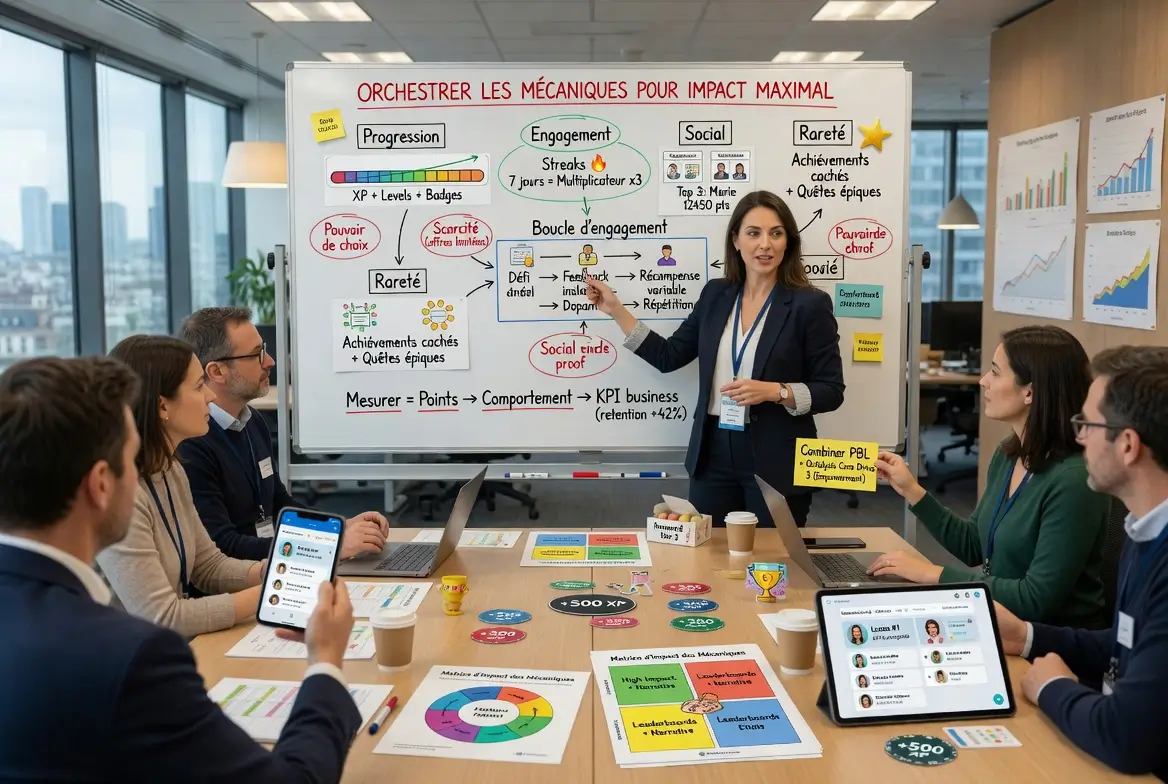
The best gamified motivational resources never work in isolation, they form an ecosystem where each element reinforces the others. Weeks 1-2 simultaneously activate weekly rankings, daily progress bar, quarterly level system and 2 easy badges for quick wins. Users immediately understand position and trajectory.
Weeks 3-4 launch a closed challenge (e.g. “Digital week: 10 video calls unlock badge”) combined booster Thursday (x1.5 points). This combination creates urgency without changing the existing leaderboard. Weeks 5-8 maintain bars and levels but deactivate leaderboards, boosters, and challenges, allowing integration and celebration. This break prevents fatigue.
Weeks 9-12 repeat with variation: new challenge (focus on customer satisfaction vs sales), new distribution of leaderboards (by region vs product), new badges. This rotation makes the gamification mechanics “fresh” and renews the attention of participants. Validation at 25,000+ users Objow: +60% time savings, +18% KPI performance.
The most frequent error in orchestration remains the simultaneous launch of all functionalities. This cognitive overload discourages users instead of motivating them. So, take a gradual approach: a simple ranking the first week, then add a badge the following week, a challenge the third. Each new mechanic should be accompanied by clear communication explaining how it works and what its rewards are. Businesses that follow this gradual progression obtain an adoption rate of 85% compared to 52% for those that activate everything simultaneously. This difference confirms that the implementation strategy counts as much as the choice of the mechanics themselves.
Activate the levers that transform your B2B teams
The levers of play applied to B2B are not gadgets, they are behavioral activation systems. Rankings, badges, challenges, bars and boosters address fundamental motivations. Combined intelligently, they generate +83% engagement and +18% improved performance. The gamification market represents 11.94 billion USD in 2021, should reach 25.7 billion in 2025. Gallup confirms that employees who followed gamified onboarding have 69% more chances to stay longer than 3 years.
Ready to transform your teams? Discover the fundamental principles of gamification and their application to your context. See also our guide on engagement profiles and behavioral drivers To adapt The drivers of gamification to your teams. Explore 14 concrete ideas for business challenges and check out our in-depth study on gamification and training to boost performance. Request a free Objow demo to orchestrate rankings, badges, challenges, and boosters in your specific context.
Frequently asked questions about gamification mechanics
What is the delay before observing the first results of gamification mechanics?
The first results appear between 2 and 4 weeks if the levers are well calibrated to your context. Sales teams observe a 15-25% increase in activity from week 2. Ford Canada observed +100% of actions per user in exactly 5 weeks. Sustainable engagement depends heavily on the monthly rotation of structured gamified approaches and their close alignment with real organizational goals, not superficial gadgets.
Do gamification mechanics really work for non-commercial teams?
Absolutely, they adapt by profession. For customer support, activate quick resolution badges and response time challenges. For operations, rankings by productivity or quality. For HR, recruitment challenges. For training, certification badges. Bartle's taxonomy shows that even less competitive profiles engage when fun motivational levers address their intrinsic motivation. MGEN gamified 1,200 non-commercial managers with measurable success in 2026, confirming the universality of these systems.
How to avoid unhealthy competition with gamification mechanics?
The key lies in calibration and plurality. Create several simultaneous leaderboards: by region, by product, by relative progression. Each employee becomes “top 1" in at least one simultaneous ranking, eliminating the feeling of exclusion. Second, reward effort and improvement, not just absolute results. Third, incorporate collaborative challenges requiring cooperation. CNP Assurances combines individual rankings and team challenges to transmute toxic competition into healthy and creative competition.
What is the optimal number of gamification mechanics to be implemented simultaneously?
Too much creates cognitive confusion, too little lacks impact. Optimal formula: 1 main mechanic (ranking) + 2-3 secondary mechanics (badges, progress bar) + 0-1 variable (booster, challenge). That's 3-5 total mechanics maximum. Objow data (25,000+ users) shows that 4 fun engagement mechanisms generate optimal engagement. Beyond 6 simultaneous mechanisms, engagement falls by 20-30% because cognitive overload dominates psychological benefits.
Can gamification mechanisms replace attractive remuneration?
No absolutely. Corporate gamification tools complement remuneration, never replace it. Mechanical rewards (day off, exclusive training, increased responsibility) work remarkably well combined with fixed remuneration. PepsiCo generates +92% DN rate via a compound approach combining salary, bonus and gamified motivational drivers. Motivational research confirms that money alone is not enough: people also want autonomy, perceived competence, and a sense of belonging.
How to measure the impact of gamification mechanisms on KPIs?
Measure in duplicate: firstly, the engagement with professional fun devices (use, badges obtained, participation, challenges), secondly, the impact on business KPIs (turnover, productivity, customer satisfaction, customer satisfaction, employee retention). Set up a simple A/B test: compare KPIs 4 weeks before activation versus 4-8 weeks after. Objow observes: +83% user engagement, +60% operational time savings, +18% improvement in business KPIs, +16% retention 12 months. Also install a monthly satisfaction survey to measure qualitative impact and adjust the levers of play applied to B2B based on real feedback.